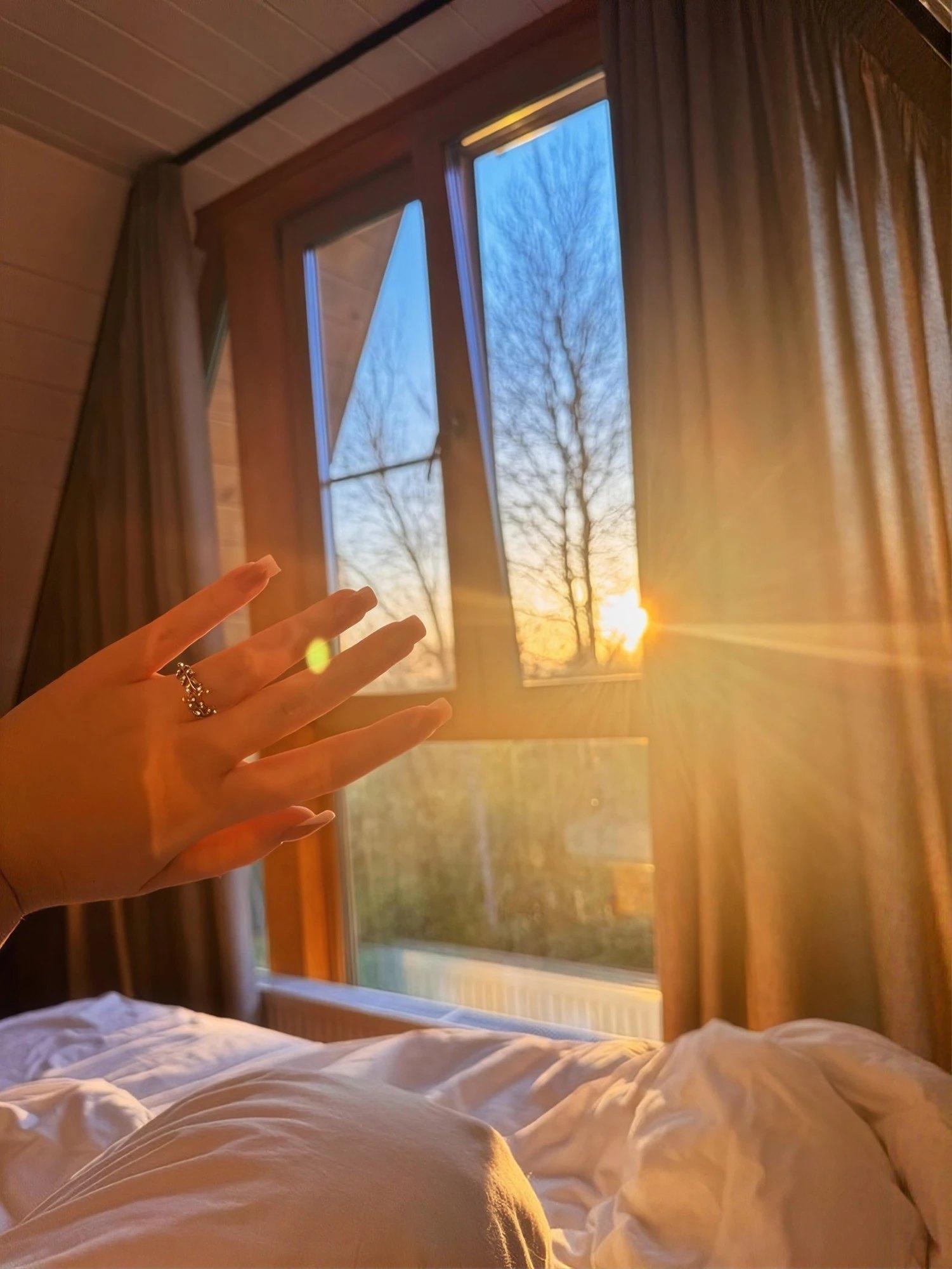
How to stop scrolling in bed with a night routine you'll like

To stop scrolling in bed, make your phone hard to reach and make bedtime nice enough that you don't miss it. About an hour before lights out, plug your phone in across the room or outside your bedroom. Then fill that hour with small things that feel good: a warm shower and skincare, a five-minute list of tomorrow's to-dos, a stretch, and a paper book in bed. It also helps to get some free time earlier in the evening, because a lot of late-night scrolling is really about wanting time to yourself.
The rest of this post covers why it happens, what the research on phones and sleep shows (including where it's shaky), and a night routine without your phone that you can copy tonight.
Why you keep scrolling in bed
You finally get into bed, open TikTok "for five minutes," and somehow it's 1:40am and you're watching a stranger retile their bathroom.
Researchers call this bedtime procrastination, defined in a 2014 paper in Frontiers in Psychology as going to bed later than you meant to when nothing outside you is stopping you. Online it's called revenge bedtime procrastination. The "revenge" part is what makes it so relatable: school, work and other people took your whole day, so you stay up to get some time that's yours.
That time usually goes to your phone. In a 2020 study in the journal Sleep, 106 young adults filled in time-use diaries. People who often put off bedtime spent about 61 more minutes on their phones in the three hours before bed than people who didn't. Stress matters too. In two daily diary studies published in 2020, people delayed bedtime more after stressful days, mostly the ones who believed self-control runs out as the day goes on.
You've got company. In a 2022 survey for the American Academy of Sleep Medicine, 93% of Gen Z respondents said they had lost sleep by staying up past their bedtime on social media.
The format makes it harder to stop. A book has chapters and a show has end credits, while a feed has no last page, so "one more" never feels like a real decision.
What the research says about phones and sleep
A lot of advice about using your phone before bed blames blue light. The evidence there is more mixed than it sounds.
Blue light is only part of it
Lab studies have found that hours of reading on a bright screen can delay sleep (our guide to things to do instead of scrolling covers one well-known example). Fixes that only filter the light haven't done much in real life, though. In a 2021 study in Sleep Health, 167 young adults aged 18 to 24 who use iPhones were randomly put into three groups for a week: phone with Night Shift on, phone with Night Shift off, or no phone at all in the hour before bed. Wrist trackers found no difference in sleep between the groups overall. Among people who averaged more than 6.8 hours of sleep, the no-phone group slept best, and Night Shift didn't close that gap.
Blue light glasses are a similar story. A 2023 Cochrane review found six small trials that measured sleep. Three showed better sleep scores and three didn't, and the reviewers rated the evidence very low certainty.
Keep Night Shift on if you like it. Just don't expect it to fix bedtime on its own.
What seems to matter more
The bigger issue looks like time. Scrolling pushes bedtime later, and later bedtimes add up. A 2022 meta-analysis of 43 studies linked bedtime procrastination with shorter sleep, worse sleep quality and more daytime tiredness. Most of those studies were surveys and the authors rated the evidence low quality, so it shows a link without proving which causes which.
Messages play a part too. In a 2016 survey of 844 adults, texting or taking calls after lights out went along with worse sleep quality, more insomnia symptoms and more fatigue.
For reference, the CDC says adults aged 18 to 60 need 7 or more hours a night, and suggests turning devices off at least 30 minutes before bed.
A night routine without your phone
Use this like a menu. Pick the steps that sound nice and move the times around your night. Everything is counted back from lights out.
90 minutes before: warm shower and skincare
A warm shower is a good way to start a bedtime routine for better sleep. In a 2019 meta-analysis, a warm shower or bath of about 40 to 42.5°C (104 to 108.5°F) one to two hours before bed was linked to falling asleep faster, even when it lasted only 10 minutes. The authors noted there still isn't much research on it, but it's easy to try. Do your skincare slowly afterwards, with a playlist on a speaker so your phone stays on the counter.
60 minutes before: put your phone to bed first
Before it goes away, send any last texts, check what time tomorrow starts and set your alarm. Then plug it in on your desk, a shelf across the room or in the hallway, with Do Not Disturb or a Sleep Focus on so the screen stays dark. If your phone is your alarm, our morning routine guide covers simple alarm clock swaps.
If a full hour sounds impossible, start with 20 minutes and move it earlier each week.
45 minutes before: a five-minute brain dump
Grab a notebook and write tomorrow's to-do list, as specifically as you can. In a 2018 sleep lab study, 57 young adults spent five minutes before bed writing either a to-do list or a list of things they had already done. The to-do group fell asleep faster, and the more specific their list was, the faster they fell asleep. It's one small study of people without sleep problems, so treat it as a promising idea that costs you five minutes and a pen.
If you love journaling, do that after the list. A few good things from today or half a page of thoughts both work.
30 minutes before: stretch, tidy, dim the lights
Do a few slow stretches on the floor, like a forward fold, child's pose or legs up the wall. Lay out tomorrow's outfit, fill your water glass and switch from the big light to a lamp or fairy lights. This is where you get to romanticize your life a little: a cozy blanket, a herbal tea, a candle you remember to blow out.
In bed: a paper book
Leave a book on your pillow so it's the first thing you see when you get in. Make it something easy and fun, like a romance, a cozy mystery or a reread of a favorite. Read until your eyes get heavy, then turn the light off.
The 15-minute version for tired nights
Some nights you get home late and a full routine isn't happening. These three steps are enough to keep the habit going:
- Plug your phone in across the room.
- Write down tomorrow's top three to-dos.
- Read two pages in bed.
How to make it stick
Move your me-time earlier
If revenge bedtime procrastination is behind your scrolling, a phone rule alone won't hold up. Give yourself a guilt-free block earlier in the evening, say 8 to 9pm, for whatever you want: a show, texting friends, even scrolling on the couch. When you've already had your free time, putting the phone down at 10:30 is a lot easier.
Plan the moment you usually give in
For most people the danger zone is the minute you sit on the bed with your phone in your hand. Decide ahead of time what happens instead, like "When I sit on my bed, I plug in my phone and pick up my book." A sticky note on the charger helps on nights when you're too tired to remember.
Replace the jobs your phone does at night
Most of us keep our phones by the bed for a reason, so give each job to something else:
- Alarm: a basic alarm clock or a sunrise lamp.
- White noise or sleep sounds: a small speaker or sound machine.
- Sleep story, meditation or podcast: set a sleep timer, press play, then put the phone out of reach.
If you wake up at 3am and reach for it
With your phone across the room, you'd have to get up to scroll, and that's usually enough to stop you. If you're often lying awake for a long time, or you're exhausted during the day even after a full night in bed, talk to a doctor. Ongoing sleep trouble is worth getting checked.
Expect some bad nights
You'll still scroll some nights. That's normal. Start again the next night without making it a big deal.
If you want some backup
If your phone still wins at 11pm, that's part of why we built Aura. It's an iPhone app that blocks the apps you scroll too much. You earn time back by doing healthy habits, like a timed reading or yoga session or a glass of water. Each coin is one minute of screen time, and a little white fox you get to name cheers you on.
FAQ
Why can't I stop scrolling in bed?
It's usually a mix of habit, tiredness and wanting time to yourself after a busy day. Feeds have no natural ending, and stopping gets harder when you're tired. Putting the phone out of reach works better than trying to resist it while it's in your hand.
How long before bed should I stop using my phone?
The CDC suggests turning devices off at least 30 minutes before bed. An hour gives you more room to wind down. Start with whatever you can manage and move it earlier over time.
Is it okay to use my phone in bed if Night Shift is on?
Night Shift didn't improve sleep in a 2021 study of young adults, and the evidence for blue light glasses is weak. Filters are fine to keep on, but cutting the time you spend on your phone in bed seems to matter more.
What should I do in bed instead of scrolling?
Read a paper book, journal, do a few gentle stretches or listen to a sleep story with your phone across the room. Something calm with a natural stopping point, like the end of a chapter, works best. For more ideas, see our list of offline hobbies.
Sources
- Kroese et al., Bedtime procrastination: introducing a new area of procrastination, Frontiers in Psychology (2014)
- Chung, An and Suh, What do people do before going to bed? A study of bedtime procrastination using time use surveys, Sleep (2020)
- Bernecker and Job, Too exhausted to go to bed: implicit theories about willpower and stress predict bedtime procrastination, British Journal of Psychology (2020)
- American Academy of Sleep Medicine, Are you TikTok tired? 93% of Gen Z admit to staying up past their bedtime due to social media (2022)
- Duraccio et al., Does iPhone Night Shift mitigate negative effects of smartphone use on sleep outcomes in emerging adults?, Sleep Health (2021)
- Singh et al., Blue-light filtering spectacle lenses (review), Cochrane Database of Systematic Reviews (2023)
- Hill et al., Go to bed! A systematic review and meta-analysis of bedtime procrastination correlates and sleep outcomes, Sleep Medicine Reviews (2022)
- Exelmans and Van den Bulck, Bedtime mobile phone use and sleep in adults, Social Science and Medicine (2016)
- Centers for Disease Control and Prevention, About sleep (2024)
- Haghayegh et al., Before-bedtime passive body heating by warm shower or bath to improve sleep: a systematic review and meta-analysis, Sleep Medicine Reviews (2019)
- Scullin et al., The effects of bedtime writing on difficulty falling asleep: a polysomnographic study comparing to-do lists and completed activity lists, Journal of Experimental Psychology: General (2018)